Floating
Offshore Wind Energy Solutions with Optimal Stability and Efficiency
Our floating turbines are engineered to harness offshore wind energy efficiently. Mounted on floating platforms in counter-rotating pairs, the opposing high-torque forces neutralize each other, substantially reducing the yawing motion being transferred into the platform and improving overall stability. This makes the architecture particularly well suited to deep-water deployment, where wind speeds are stronger and more consistent.
Flag Turbines’ variable-pitch architecture continuously optimizes lift, torque and drag. The large blades generate high lift forces, while the blade-pitching mechanism maintains the optimum angle of attack throughout each rotation. Our omnidirectional design captures wind from all directions without the need for repositioning, making it well suited to the dynamic conditions at sea.
Our much lower-profile turbines can also be deployed farther offshore, reducing their presence on the horizon and minimizing visual impact on coastal communities.
Prioritising Marine Life
Flag Turbines’ floating VAWT (vertical-axis wind turbine) technology offers distinct advantages for marine ecosystems. Unlike traditional horizontal-axis wind turbines (HAWTs) with monopile foundations that require noisy high-impact pile-driving, our floating VAWTs utilise moored floating platforms, which substantially reduces underwater vibration during installation and operation.
Traditional turbines have a constant ongoing operational vibration that travels down the monopile into the seabed. In contrast, our turbines, with their unique vibration profile, have minimal disturbance in marine environments. This minimises interference with marine mammals that rely on echolocation, such as whales and dolphins. This vastly reduced noise footprint supports healthier habitats, making our floating VAWT technology an ecologically responsible choice for sustainable energy in marine settings.
BENEFITS OF OUR FLOATING MODEL
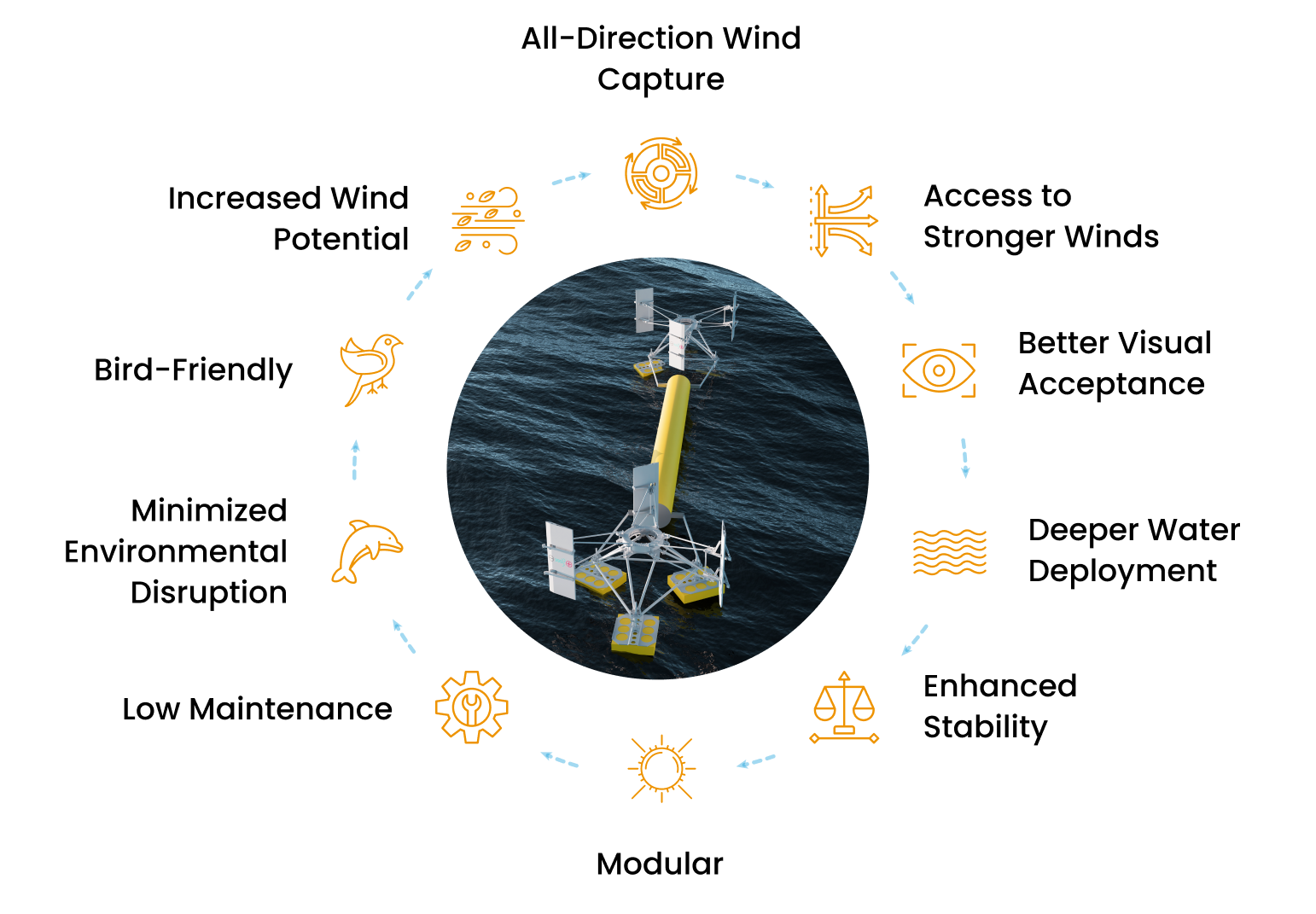
All-Direction Wind Capture
Access to Stronger Winds
Better Visual Acceptance
Deeper Water Deployment
Enhanced Stability
The vertical axis design of Flag Turbines and their lower centre of gravity provide greater stability on floating platforms, making them more resilient in rough sea conditions.
Modular
Low Maintenance
Minimized Environmental Disruption
Bird-Friendly
Increased Wind Potential
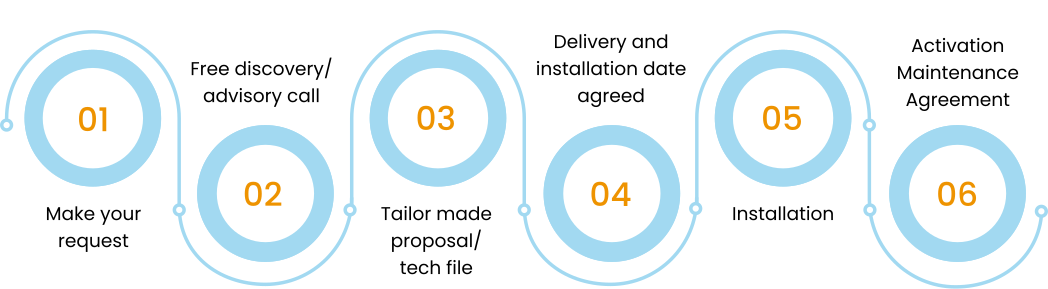
Delivery and setup process
Technical Information
Dimensions (m, wxhxl): 4 x 4 x 17
60 x 60
Weight (g): 5.000 kg
Output: 100 VDC, battery storage
Generator power (W): 2×25 kW
Minimum wind: 3 km/h or 2 mph
Maximum wind: 85 km/h or 52 mph
Brake: Aerodynamic
EU Compliance
Environmental noise 2002/49/EC
Safety IEC-61400